Understanding MRI Technology: Comparing 3T and 1.5T MRI Scans

Written by: Dr. Nitin Shori
Magnetic Resonance Imaging (MRI) has become an essential tool in modern medical diagnostics, known for its ability to produce detailed images of the body’s soft tissues without harmful ionizing radiation. As technology advances, MRI machines have evolved, offering varying levels of magnetic field strength measured in Tesla (T). The most common types of MRI scans are 1.5T and 3T, each with its advantages and disadvantages. This article explores the differences between these two MRI technologies, helping you understand which might be more suitable for your specific medical needs.
What is MRI?
MRI, or Magnetic Resonance Imaging, is a non-invasive imaging technique that uses strong magnetic fields and radio waves to generate detailed images of the organs and tissues inside the body. It is particularly effective for imaging soft tissues, such as the brain, spinal cord, muscles, and ligaments, which are not as clearly visible with other imaging modalities like X-rays or CT scans.
The Basics: 1.5T and 3T MRI
The primary distinction between 1.5T and 3T MRI scanners lies in their magnetic field strength. A 1.5T MRI has a magnetic field strength of 1.5 Tesla, while a 3T MRI has a magnetic field strength of 3 Tesla, making it twice as powerful. This increased strength has a significant impact on the quality and detail of the images produced.
Advantages of 1.5T MRI
- Cost-Effective: 1.5T MRIs are generally more affordable than their 3T counterparts. This makes them a more accessible option for routine diagnostic imaging.
- Wide Availability: 1.5T MRI machines are more commonly available in hospitals and imaging centers, ensuring that patients have easier access to necessary scans.
- Adequate for Standard Diagnoses: For most routine medical evaluations, a 1.5T MRI provides sufficient image quality. It is effective for diagnosing a wide range of conditions, including joint injuries, abdominal issues, and certain brain disorders.
Disadvantages of 1.5T MRI
- Lower Resolution: The images produced by a 1.5T MRI are of lower resolution compared to those from a 3T MRI. This can limit its effectiveness in detecting small or subtle abnormalities.
- Longer Scan Times: Due to its lower magnetic field strength, a 1.5T MRI may require longer scan times to achieve the desired image quality, which can be less comfortable for patients.
Advantages of 3T MRI
- Higher Resolution: A 3T MRI produces higher-resolution images with greater detail, which is crucial for detecting small abnormalities, especially in complex areas like the brain and spinal cord.
- Shorter Scan Times: The stronger magnetic field allows for shorter scan times while maintaining high image quality, enhancing patient comfort.
- Advanced Imaging Capabilities: 3T MRIs are particularly useful for advanced imaging techniques, such as functional MRI (fMRI) and spectroscopy, which provide detailed information about brain activity and chemical composition of tissues.
Disadvantages of 3T MRI
- Higher Cost: The advanced technology and superior imaging capabilities of 3T MRIs come at a higher cost, making them less accessible for routine diagnostics.
- Artifact Susceptibility: Higher magnetic field strength can lead to increased susceptibility to artifacts, which are distortions in the images caused by patient movement, metal implants, or other factors.
- Less Availability: 3T MRI machines are not as widely available as 1.5T machines, which can make it challenging to find a facility that offers this advanced imaging option.
Choosing Between 1.5T and 3T MRI
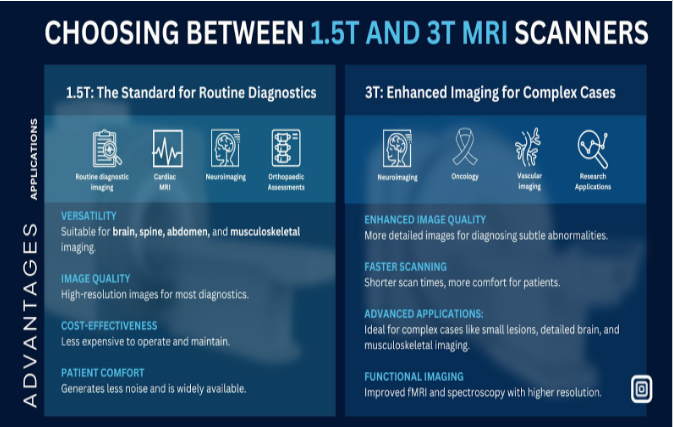
The choice between a 1.5T and a 3T MRI depends on several factors, including the specific medical condition being investigated, the level of detail required, patient comfort, and cost considerations.
- Routine Imaging: For routine diagnostic purposes, such as evaluating joint injuries, abdominal pain, or standard brain imaging, a 1.5T MRI is often sufficient and more cost-effective.
- Complex Diagnoses: For more complex conditions, particularly those involving the brain, spinal cord, or small anatomical structures, a 3T MRI may be necessary due to its higher resolution and detail.
- Neurological and Oncological Cases: In neurology and oncology, where detailed images are crucial for detecting small tumors, lesions, or abnormalities, a 3T MRI is often the preferred choice.
Cost and Availability Considerations
- 3T MRI: These machines are less prevalent and typically more expensive due to their advanced capabilities. Finding a facility with a 3T MRI can be challenging, and the cost can be significantly higher than a 1.5T MRI.
- 1.5T MRI: More commonly available and generally adequate for most diagnostic needs. They are also more affordable, making them accessible to a broader range of patients.
Conclusion: Choosing the Right MRI Scan
Both 1.5T and 3T MRI scans have distinct advantages and limitations. A 3T MRI offers better image quality suitable for complex diagnoses, while a 1.5T MRI is more accessible and cost-effective for routine imaging. The decision between a 1.5T and a 3T MRI should be guided by specific diagnostic needs and patient risk factors.