
Key Metrics to Include in Your Sales & Profitability Dashboard for Optimal Performance
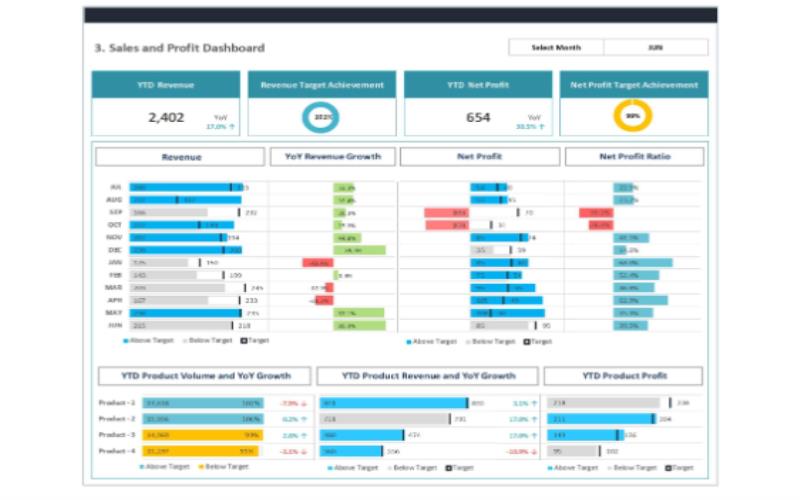
In today’s fast-paced business environment being able to analyze sales and profit data can greatly improve decision making and strategic thinking efforts. With a crafted Sales & Profitability Dashboard, in place it becomes crucial to track key performance indicators (KPIs) that mirror the vitality and future prospects of a company. This manual explores the measures that need to be integrated into such a dashboard to guarantee top notch performance and informed decision-making processes.
Key Performance Indicators for Sales
Total income
Keeping tabs on Overall Revenue Trends; This forms the core of every sales assessment by offering a quick look, into the company’s ability to generate income. It requires keeping an eye on sales figures each day, week, month or year and plays a role, in grasping the business path of growth. Analyzing Sales Performance and Targets; When companies compare their sales data with targets and previous achievements it helps them assess the success of their sales strategies and make any needed changes.
Rate of increase in sales volume
Keeping an eye on Periodic Growth Trends; The sales growth rate serves as a gauge that assesses how quickly a company’s sales volume is either rising or falling within a set timeframe. This measure assists in recognizing patterns that might signal the effectiveness of market strategies or the influence of market factors. The influence of market conditions, on sales growth is significant; examining how external elements like fluctuations in the economy competition strategies and shifts, in consumer behavior impact sales growth can assist companies in adjusting their tactics to maintain their market standing.
Key Performance Indicators for Financial Success
Understanding and Importance of Gross Profit Margin; The gross profit margin is an indicator that shows the percentage of revenue remaining after deducting the cost of goods sold (COGS) providing information, about the profitability of essential business operations. To determine the profit margin you subtract the COGS, from the revenue and divide the outcome by the total revenue. Comparing a company’s profit margin, to industry standards can reveal how it stacks up against competitors and whether it is meeting or exceeding industry norms.
Profit margin after expenses
Comprehending the profitability of a business involves considering costs in addition, to the cost of goods sold (COGS). This approach offers a view of a company’s overall profitability once all financial responsibilities have been taken care of. Using Net Margin, in Strategic Business Planning is crucial, for long term decision making as it helps companies evaluate their ability to invest in growth and ensure sustainability.
Expenses related to Goods Sold (COGS)
When looking at the expenses related to sales COGS denotes the costs linked to producing the items that a company sells. This monitoring of expenses aids, in handling profitability and setting pricing strategies in a manner. Ways to Lower Costs and Boost Profits; Finding ways to cut costs can boost profit margins directly by optimizing the supply chain or renegotiating supplier agreements.
Assessing Operational Efficiency via Cost Control Analysis. This metric gauges operating expenses, to revenue to show the portion of revenue used for administrative and sales expenditures. Evaluating health by comparing revenue and operating expenses helps determine how efficiently a company operates and manages its finances. It also provides guidance on adjusting budgets and implementing cost management strategies.
Metrics that focus on customer satisfaction and needs
Determining the expense of acquiring customers involves accounting for all expenses associated with marketing and sales efforts aimed at drawing in a new clientele, which is pivotal, for assessing the effectiveness of marketing expenditures.
Balancing customer acquisition cost (CAC) with customer lifetime value (CLTV) to ensure that the expenses of acquiring a customer do not surpass the revenue they bring in throughout their lifetime is crucial, for fostering long term business success. The significance of customer loyalty, in sales strategies is evident when there are rates of customer retention, which typically signal satisfaction, with the product or service and can greatly bolster long term business prosperity. Monitoring customer retention over time is crucial, for boosting profits in the run as it allows businesses to pinpoint methods that keep customers interested and happy.
Evaluation Criteria for Performance Analysis
Per Employee Sales
Assess Staff Efficiency, in Generating Sales Revenue. This measure aids companies in evaluating the efficiency of their staff in generating income. Is crucial, for workforce management and performance assessment. Evaluating a company’s performance by comparing its sales, per employee to industry standards offers insights into how it stacks up against competitors, in the market.
Measuring the conversion rate from leads to customers is crucial, in assessing how well sales funnels and marketing campaigns are performing. Improving Conversion Tactics, for Increased ROI; Leveraging conversion rate data can help refine sales and marketing strategies to boost the return, on investment.
Analyzing the point where costs profits.
Knowing the moment when your sales will match up with all your expenses is a factor, in financial planning and managing risks, for both product and service lines. Applying Break Analysis to Inform Pricing Choices. Leveraging insights, from break analysis can aid in establishing pricing strategies that not only offset expenses but also yield the targeted profit margins.
Calculating the Earnings Earned for Every Dollar of Sales Made is a metric that showcases how effectively a company turns its sales into profits and reflects the quality of its management. Insights, for Improving Operations Strategically. ROS offers insights that can help identify areas where operational efficiency can be improved to increase profits.
Tailoring Your Dashboard for User Friendly Navigation
Crafting Designs and User Interfaces
Tailoring Dashboards to Suit User Requirements; Ensuring that the dashboard caters, to the needs of users, within the company enhances its effectiveness and user involvement. Utilizing recommended techniques, in data visualization is essential for enhancing clarity and impact on the dashboard content by making it both informative and user friendly, for understanding and decision-making purposes.
Valuable Analysis
Utilizing Data, for Strategic Decision Making; The primary aim of a sales and profitability dashboard is to offer insights that guide immediate operational changes as well, as long term strategic decision making. Consistent Reporting and Ongoing Updates, for Enhanced Progress; Keeping the dashboard up to date with the data guarantees its relevance and offers insightful information, for continual business growth.
In closing
Adding these measurements to your Sales and Profit Dashboard can convert data into insightful information that enhances decision making and promotes a culture centered around data analysis skills. Consistently reviewing and improving these indicators guarantees that your dashboard adapts to shifting business trends and remains a resource, for decision making. Bizinfograph offers ready-to-use dashboard templates on Finance, Sales, HR and Manufacturing.


