Finding Your Soul in Albania: A Journey Through Europe’s Last Secret
There are places in the world that touch something deep within us—places that make us put down our phones, stop counting Instagram likes, and simply exist in the moment. I found that rare quality in Albania, a country I stumbled upon almost by accident and left with a transformed perspective on travel, beauty, and human connection.
This isn’t going to be your typical travel guide full of Top 10 lists and “must-see” attractions. Instead, I want to share what Albania gave me that I wasn’t even looking for: a sense of wonder I thought I’d lost somewhere between my twentieth country stamp and my hundredth sunset photo.
The Country That Time Almost Forgot
Albania emerged from decades of isolation under communist rule in the early 1990s. For nearly half a century, it was virtually closed to the outside world—no tourists, limited contact with other nations, an entire country frozen in time. When those borders finally opened, Albania didn’t immediately flood with visitors like other former Eastern Bloc countries. It remained overlooked, overshadowed by its more famous neighbors: Greece, Croatia, Italy.
Today, that’s changing. But Albania still exists in that sweet spot—discovered enough to have functional tourism infrastructure, but undiscovered enough to maintain authentic soul.
Walking through Albanian cities, you see layers of history coexisting: ancient Illyrian ruins beneath Ottoman mosques beside Italian art deco buildings next to communist-era bunkers. Nowhere have I seen such visible evidence of resilience, of a culture that absorbed influences without losing itself.
The Soul of the Albanian Landscape
Mountains That Touch the Sky
My first morning in the Albanian Alps, I woke before dawn. The guesthouse owner had mentioned the sunrise view but, exhausted from travel, I’d planned to sleep in. Something pulled me from bed—maybe the absolute silence, maybe intuition.
I walked outside to see the Accursed Mountains (what a name!) bathed in that pre-dawn blue light that photographers obsess over. Mist rose from valleys. Distant sheep bells chimed. The air tasted of pine and coming rain.
No photo I took captured it. And that failure—the inability of my camera to translate the experience—felt oddly perfect. This moment belonged to memory, not pixels.
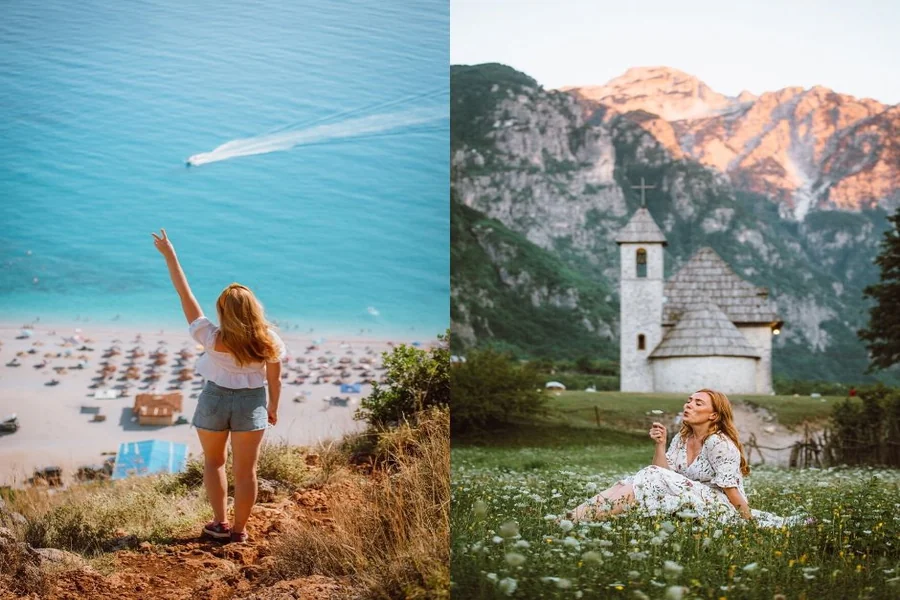
The Albanian Alps remain relatively untouched by mass tourism. The stone villages of Theth and Valbona seem to emerge organically from the mountainside. People still live traditional lives here, though increasing numbers of guesthouses signal change on the horizon. Visit these mountains not to conquer peaks but to remember how small we are, how briefly we exist, how beautiful that smallness can be.
Coastal Paradises Without the Crowds
The Albanian Riviera rivals any Mediterranean coastline I’ve experienced, yet you can still find beaches without the shoulder-to-shoulder tourists that plague Greece and Croatia.
Gjipe Beach became my sanctuary. Reaching it requires a thirty-minute hike through a canyon—just enough effort to deter the casual beach-goer. The reward? A crescent of white pebbles embraced by towering cliffs, impossibly turquoise water, and usually fewer than twenty people scattered across the entire beach.
I spent five hours there one Tuesday, reading perhaps ten pages of my book. The rest of the time I simply existed: swimming, floating, watching light patterns on the water, feeling sun on skin. When did we forget how to do nothing beautifully?
The magic of Albanian beaches lies in their emptiness. Arrive in July or August and yes, popular spots like Ksamil fill up. But drive ten minutes further, hike down a rough path, ask a local for their favorite spot, and you’ll find your own slice of paradise.
The Blue Eye: Nature’s Perfect Metaphor
Near Sarandë lies the Blue Eye—a natural spring that pumps impossibly blue water from underground depths exceeding 50 meters. The exact depth remains unknown; divers have reached 50 meters without finding the bottom.
Standing beside it, I understood why locals consider it sacred. The water’s blue defies photography, defies description, almost defies belief. Tour groups arrive mid-morning, take their photos, and leave. Stay longer. Watch how the light changes the blue’s intensity. Notice how the forest around the spring creates a chapel-like atmosphere.
The Blue Eye became my metaphor for Albania itself: depths we can’t fully plumb, beauty that exceeds our ability to capture it, mysteries we don’t need to solve.
The People: Albania’s Greatest Gift
Hospitality as a Sacred Duty
Albanian hospitality isn’t a tourist industry slogan—it’s a cultural cornerstone rooted in an ancient code called “Besa” that governs honor, trust, and the treatment of guests. To Albanians, a guest is sacred. This isn’t hyperbole.
In a mountain village, my rental car developed a flat tire. Before I could fully assess the situation, three men appeared from a nearby house. They changed the tire, refused payment, and insisted I come inside for coffee. Their mother—who spoke no English—communicated through smiles and gestures that I should sit, eat, relax.
I spent two hours with that family. We communicated through broken Italian, Google Translate, and the universal language of shared food and laughter. When I left, they loaded my car with homemade cheese and jars of preserved fruit. Refusing felt impossible.
This wasn’t unique. Time and again, Albanians went absurdly out of their way to help me. Not because they wanted tips or reviews, but because I was a guest in their country and their honor demanded they help.
The Younger Generation’s Optimism
Albania has the youngest population in Europe, and that youth brings palpable energy and optimism. Young Albanians are building businesses, learning languages, creating art, and shaping their country’s future with remarkable determination.
I met a woman in Tirana who’d returned from studying in London to open a bookshop-café focused on Albanian literature in translation. She could have stayed in the UK, earned more money, lived more comfortably. “But Albania needs people who come back,” she said simply. “I want to build something here.”
That sentiment—choosing to invest in Albania’s future rather than seeking easier opportunities elsewhere—runs through conversations with young Albanians. They possess realism about their country’s challenges paired with determination to address them. Cynicism hasn’t hardened them yet.
Seeing History in Faces
Albania’s older generation carries history in their faces. Men in village cafés who lived through communism, who remember when cars were rare and borders were closed. Women who raised families during the chaotic ’90s when the government collapsed and pyramid schemes devastated the economy.
These elders don’t often speak English, but find a translator and their stories will humble you. Stories of resilience, adaptation, and maintaining humanity through absurd circumstances. Albania suffered under one of the world’s most repressive communist regimes, then endured near-anarchy in the 1990s, and has rebuilt with remarkable speed.
Understanding this history transforms how you see Albania. The country’s openness to visitors, its striving for European integration, its entrepreneurial energy—these aren’t random characteristics. They’re responses to decades of isolation and hardship.
Cities That Tell Stories
Berat: The City of Windows
UNESCO designated Berat a World Heritage site for its Ottoman-era architecture, but statistics don’t capture what makes Berat special. The city cascades down a hillside in layers of white stone houses, each with distinctive windows that give Berat its nickname. At sunset, when light touches those white walls, the city glows.
I rented a room in the Mangalem quarter, the historic Muslim neighborhood across the river from the Christian Gorica quarter. Each morning, I’d wake to muezzin calls echoing through narrow streets, have coffee at a café beside a 15th-century mosque, then climb to the castle for views across the valley.
Berat moves slowly. People still hang laundry across ancient streets. Old men gather in courtyards to play backgammon. Women sell homemade jams from their doorways. Tourism exists but hasn’t consumed the city’s soul.
One evening, I got magnificently lost in Berat’s maze-like streets. A woman hanging laundry noticed my confusion and insisted—through gestures and fragments of Italian—that I follow her. She led me through a confusing series of staircases and alleys to a terrace I never would have found. The sunset view she’d gifted me remains one of my most treasured travel memories.
Gjirokastër: Stone City in the Mountains
If Berat feels like a gentle grandmother, Gjirokastër is her stern but fascinating uncle. This stone city perches on a steep hillside, its houses built from gray stone with distinctive slate roofs. The castle looming over the city has witnessed Turkish rule, Albanian kingdoms, Italian occupation, and communist dictatorship.
Walking Gjirokastër’s cobbled streets requires good shoes and better knees—everything is uphill or downhill, nothing is level. But the effort rewards you. The city possesses an austere beauty, like something from a fairy tale written before Disney sanitized them.
I visited the Ethnographic Museum—communist dictator Enver Hoxha’s childhood home—which preserves traditional Albanian life. The juxtaposition felt surreal: this beautiful example of Ottoman residential architecture birthed the man who tried to erase Albania’s past in his vision of the future.
Tirana: The Capital of Color
Tirana defies expectations. Rather than preserving communist-era grayness, the city painted itself in riots of color. Former mayor (later prime minister) Edi Rama, himself an artist, initiated a project painting previously drab buildings in bold, cheerful patterns. The effect is striking—instead of depressing Soviet-style blocks, you find orange buildings with green polka dots, yellow edifices with purple stripes.
The city pulses with energy. Skanderbeg Square anchors the center—a massive public space that somehow works despite being surrounded by architectural styles spanning centuries. The National History Museum, Et’hem Bey Mosque, opera house, and modern shops all coexist around this plaza.
Tirana’s Blloku neighborhood, formerly reserved for communist party elites and closed to ordinary citizens, now hosts the city’s trendiest bars, restaurants, and boutiques. Young Albanians pack cafés to drink espresso, smoke cigarettes, and debate politics or art.
The city isn’t conventionally beautiful, but it’s alive in ways that perfectly manicured European capitals sometimes aren’t. Tirana is still becoming itself, still figuring out its identity, and that makes it fascinating.
Practical Soul-Searching: The How-To
Getting There and Getting Around
Most visitors fly into Tirana International Airport. From there, Albania reveals itself best to those willing to drive. Public transportation exists but doesn’t reach Albania’s most soulful corners.
Renting a car provides freedom to chase sunsets, take unmarked roads to villages Google Maps doesn’t know, and stop anywhere that calls to you. While driving in Albanian cities requires attention and patience, the countryside rewards you with scenic routes and the flexibility to explore spontaneously.
For those seeking reliable transportation with local expertise, established car rental providers in Tirana offer everything from economical compact cars to comfortable SUVs suitable for mountain roads, with convenient pickup at the airport to start your journey immediately.
When to Visit for Maximum Soul
July and August bring perfect beach weather and maximum crowds. For soulful travel, consider:
September-October: The Riviera remains swimmable, mountains glow with autumn colors, and you’ll often be alone at historic sites. Light slants perfectly for photography and reflection.
May-June: Wildflowers blanket mountain meadows, weather is ideal for hiking, and seaside towns wake from winter without summer chaos.
Even winter has its magic: Snow transforms the Albanian Alps into silent wonderlands. Coastal cities slow down, revealing local life hidden during tourist season. Coffee tastes better when you’re the only foreigner in the café.
Budget Considerations
Albania’s affordability allows extended travel without financial anxiety. Quality meals cost €8-15. Comfortable accommodation runs €25-50 per night. Museum entries rarely exceed €5. This means your money stretches further, allowing longer stays to truly absorb places rather than rushing through them.
What Albania Taught Me
Slowing Down Isn’t Inefficiency
Albanian time moves differently. Cafés don’t rush you. Buses leave when they’re ready. Conversations meander. Initially, this frustrated my American efficiency mindset. Eventually, I surrendered to it.
Drinking morning coffee became a meditation. The concept of “making time” for experiences disappeared—time simply existed to be filled with attention and presence.
Beauty Doesn’t Require Perfection
Albania’s infrastructure is improving but imperfect. Roads surprise you. Hotels sometimes lack hot water. Plans require flexibility. These imperfections don’t diminish beauty—they accent it with reality.
The broken tiles in that guesthouse bathroom? They framed the window overlooking the valley. The bumpy road to that secluded beach? It made arrival feel like earned treasure.
We’re trained to expect and demand perfection in travel. Albania taught me that perfection is less interesting than authenticity.
Human Connection Transcends Language
My Albanian is limited to “hello,” “thank you,” and “delicious.” Yet I had profoundly meaningful interactions with people who spoke no English. Shared meals, mutual laughter, collaborative problem-solving, and simple kindness create connections that vocabulary can’t enhance.
Presence Is the Ultimate Luxury
Instagram can wait. Email will still be there. The work deadline will get met. What can’t be recovered is this sunset, this conversation, this moment of existence in a place you’ll likely never return to.
Albania’s relative lack of WiFi in remote areas wasn’t a limitation—it was liberation. Without constant digital tethering, I actually experienced my experiences rather than documenting them.
The Soul You’ll Find
I went to Albania for beaches and cheap travel. I found something else entirely: a reminder that the world still holds surprises, that beauty exists outside famous landmarks, that people’s kindness can be overwhelming, and that slowing down reveals more than rushing ever will.
Albania won’t appeal to luxury seekers or those needing five-star predictability. It requires embracing uncertainty, accepting imperfection, and bringing patience and openness.
But if you’re seeking authentic experiences, genuine human connection, stunning natural beauty, and that increasingly rare feeling of discovering something truly special—Albania will not disappoint.
You’ll return changed. Not dramatically, perhaps, but in small ways that matter: more patient, more present, more appreciative of imperfect beauty, more open to unexpected kindness.
The Albanian word “shpirt” means soul. The country has it in abundance. Come find yours among the mountains, beside the sea, and in the faces of people who still remember how to be human first and everything else second.
The Albania you’ll discover exists in those in-between moments: the conversation with a shepherd on a mountain trail, the sunset viewed from a castle wall, the home-cooked meal shared with strangers who become friends, the quiet morning beside the Blue Eye before the crowds arrive.
This is travel that touches the soul. Albania is ready when you are.