40G QSFP+ Optical Transceiver Modules: Frequently Asked Questions (FAQs)
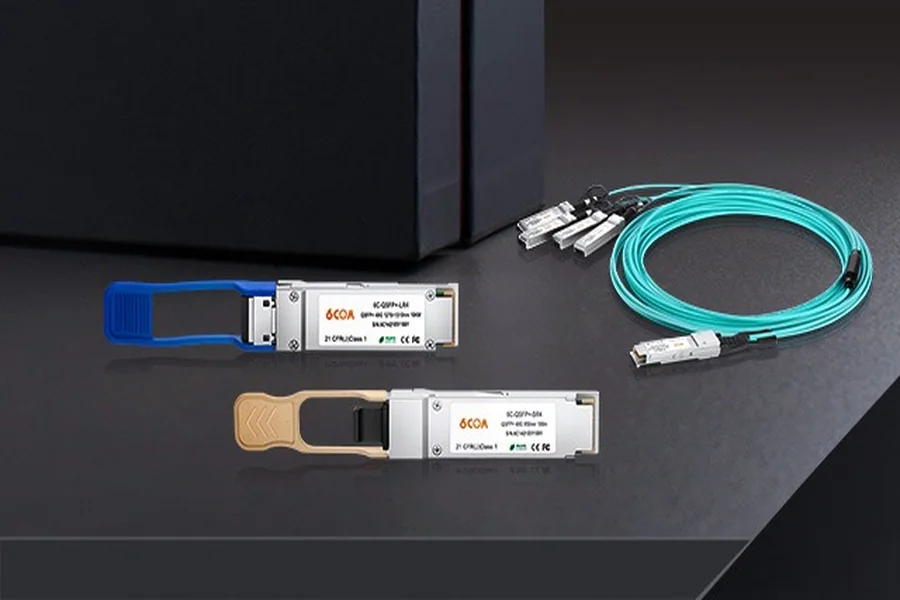
40G Quad Small Form-factor Pluggable Plus (QSFP+) optical transceiver modules have been a cornerstone of high-speed data center and high-performance computing networks for years. As the migration to 100G, 200G, and 400G accelerates, 40G infrastructure remains widely deployed. Whether you are maintaining existing hardware, planning an upgrade, or simply seeking to understand this critical technology, this FAQ addresses the most common questions about 40G QSFP+ modules.
What is a 40G QSFP+ Transceiver?
A 40G QSFP+ is a hot-swappable, compact optical transceiver used for high-speed network connections. It interfaces network equipment (like switches, routers, servers) with fiber optic cables. The “Quad” in its name signifies that it aggregates four independent 10G channels (electrical lanes) to achieve a total data rate of 40 gigabits per second. It is an evolution of the QSFP form factor with enhanced specifications for 40G data rates.
What are the Main Types of 40G QSFP+ Modules?
The most common types are distinguished by their reach, cable type, and technology:
- QSFP+ SR4 (Short Reach): Uses multimode fiber (MMF), typically OM3 or OM4. It has an MPO/MTP connector and uses four parallel 10G lanes for transmission and reception. Reach is up to 100m over OM3 and 150m over OM4.
- QSFP+ LR4 (Long Reach): Uses single-mode fiber (SMF) and employs Wavelength Division Multiplexing (WDM) technology. It multiplexes four 10G optical lanes at different wavelengths into a single fiber strand, and uses a standard duplex LC connector. Reach is up to 10km. The 40GBASE-LR4 extended version supports max. reach u to 20km, i.e. QT-QSFP+-LH4.
- QSFP+ ER4 (Extended Reach): Similar to LR4 but with higher-powered optics for reaches up to 40km over single-mode fiber.
- QSFP+ Direct Attach Copper (DAC): A passive or active copper cable assembly with QSFP+ connectors on both ends. Used for very short-distance connections (typically 1-7m, with active cables up to 10m) within racks or between adjacent racks.
- QSFP+ Active Optical Cable (AOC): An integrated optical cable with embedded transceivers. Similar in use to DAC but uses fiber, offering longer reaches (typically up to 100m), lighter weight, and better electromagnetic interference (EMI) immunity.
Can a 40G QSFP+ Port be Used for 10G Connections?
Yes, through a process called breakout. A 40G QSFP+ port (e.g., SR4) can be split into four independent 10G SFP+ connections using a breakout cable. This cable has one MPO/MTP connector on one end (plugging into the 40G switch port) and four LC or SC connectors on the other end (connecting to 10G devices). This allows efficient use of high-density 40G switch ports to connect to multiple 10G servers or switches.
What is the Difference Between SR4 and LR4, and How Do I Choose?
The choice is primarily based on distance and fiber infrastructure.
- SR4 is for short distances inside a data center (within or between rows). It requires multimode fiber (OM3/OM4) with an MPO/MTP connector. It is generally the most cost-effective solution for reaches under 150m.
- LR4 is for longer distances (up to 10km) between buildings or across campuses. It requires single-mode fiber (OS2) with standard LC connectors. It is more expensive than SR4 but offers far greater reach.
Always audit your existing fiber plant (fiber type and connector type) before selecting a module.
Are QSFP+ Modules from Third-Party Vendors Compatible with My Switch?
Most network equipment from major vendors (Cisco, Arista, Juniper, etc.) uses a coded software lock (e.g., EEPROM checks) to restrict operation to their own branded, often more expensive, transceivers. However, reputable third-party manufacturers produce fully compatible, MSA (Multi-Source Agreement) compliant modules that are programmed to work seamlessly with specific OEM equipment. Using such compatible modules can lead to significant cost savings (often 70-80%) while maintaining performance and reliability. Ensure your vendor offers a lifetime warranty and robust compatibility guarantees.
What is MSA Compliance and Why is it Important?
The MSA is an agreement between multiple transceiver manufacturers to standardize physical dimensions, electrical interfaces, and communication protocols. MSA compliance ensures that a QSFP+ module from one vendor will be mechanically and electrically compatible with a port from another MSA-compliant vendor. It is the foundation of interoperability in the optical components market.
How Can I Tell if a QSFP+ Module is Faulty?
Common troubleshooting steps include:
- Check the switch/logs for error messages or alerts for the specific port.
- Verify that the link is not up or is unstable.
- Use the show interface command (or equivalent) to check for high error counts (CRC, FCS).
- Swap the module with a known working one from another port. If the problem follows the module, it’s likely faulty.
- Inspect the optical connectors for dust or damage. Clean fibers with an appropriate cleaner.
- Check the compatibility coding if using a third-party module.
How Do I Handle and Maintain QSFP+ Modules?
- Always use a dust cap on optical bores and connectors when not in use.
- Clean fiber connectors before insertion using a professional fiber optic cleaning pen or cassette.
- Avoid touching the optical ends or the electrical gold-plated contacts.
- Insert and remove modules carefully using the release latch, ensuring they are fully seated.
- Store modules in an anti-static bag in a cool, dry place.
Is 40G QSFP+ Still Relevant with the Rise of 100G/400G?
Absolutely. While new deployments often leap to 100G or higher, 40G remains a massive installed base. It provides a critical, cost-effective aggregation layer for 10G servers and is often used for switch-to-switch spine-leaf connections in many operational data centers. The vast availability of affordable, high-quality 40G QSFP+ modules makes it a practical choice for network expansion, upgrades from 10G, or maintenance of existing infrastructure.
What Should I Consider When Purchasing 40G QSFP+ Modules?
- Compatibility: Ensure it is specifically coded for your switch/device brand and model.
- Type (SR4/LR4/DAC/AOC): Match it to your required distance and fiber type.
- DOM Support: Digital Optical Monitoring provides real-time diagnostic data (temperature, TX/RX power, etc.) via the switch interface—a valuable feature.
- Vendor Reputation: Choose a supplier with proven industry experience, technical support, and strong warranties.
- Certification & Testing: Opt for vendors who perform rigorous pre- and post-production testing to ensure compliance and performance.
In conclusion, 40G QSFP+ transceivers are mature, reliable, and economical building blocks for high-speed networks. Understanding their types, applications, and compatibility considerations is key to designing, maintaining, and cost-effectively scaling network infrastructure.