Why We Still Bet on SMS Over RCS and WhatsApp
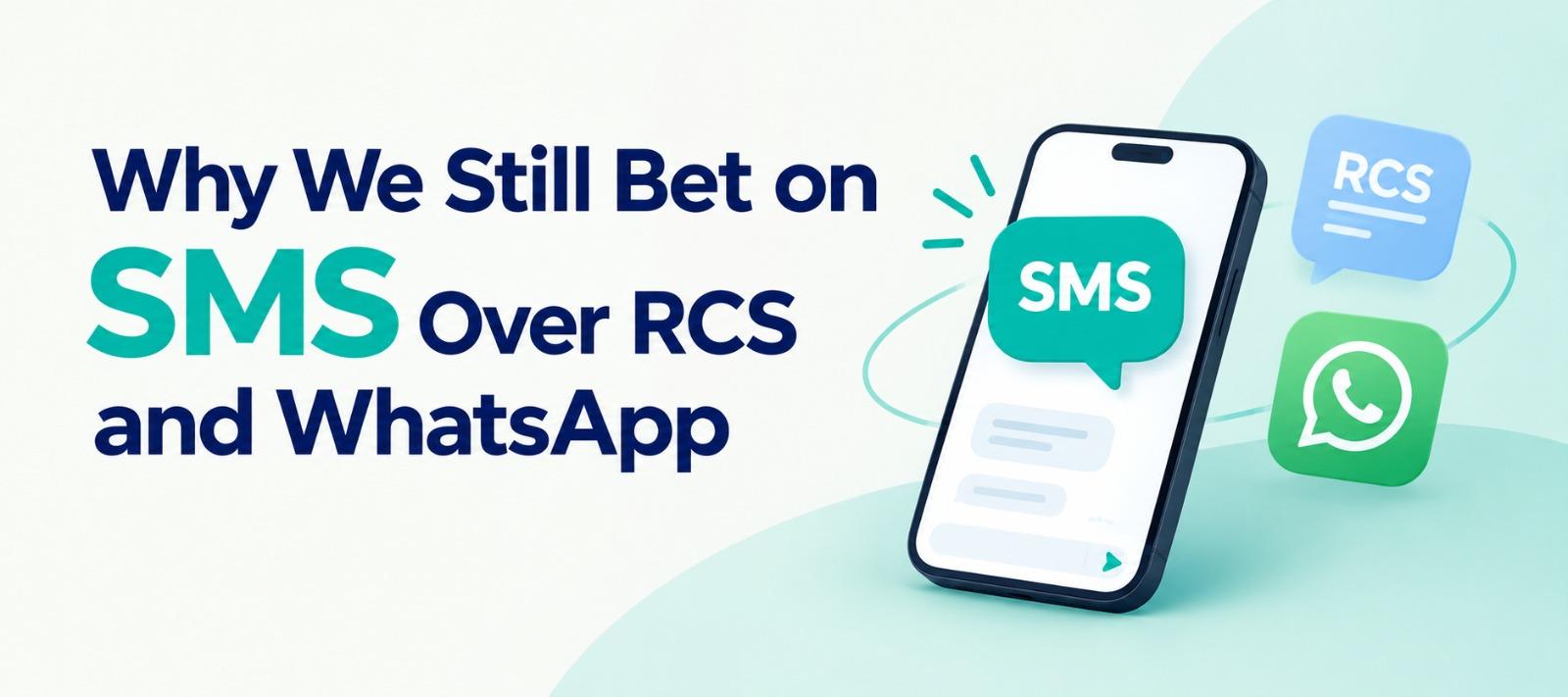
Someone declares SMS dead every year. RCS will finish it off. WhatsApp already did. Plain text belongs to the Nokia keypad era.
Then those same people order something online and wait for an OTP that arrives by SMS.
That gap between the story and the reality says a lot about how business messaging actually runs in India. Newer channels beat SMS at plenty of things. What they haven't matched is the one thing SMS has always done: reach everyone, every time, with no conditions attached.
Give the newer channels their due first
The criticism below only works if you accept what RCS and WhatsApp genuinely do well.
RCS turns a text thread into something closer to an app. You get branded sender profiles with a verified badge, product carousels, quick-reply buttons, read receipts, and proper images. A delivery update can carry a live map instead of a plain tracking link. Apple adding RCS support on iPhone killed the biggest objection people had, which was that Android owned it entirely.
WhatsApp pushes further still. Two-way conversations, rich media, chatbots, payments in some markets, and an audience in India that comes close to universal. Nothing beats it for support and sales conversations. A customer asks a question, gets an answer, and places an order without ever leaving the thread.
Both look like the future. Neither replaces SMS yet, and the reasons are boring and structural.
Reach settles the argument
Every mobile phone ever sold can receive an SMS. No app, no data plan, no account, no login, no minimum OS version. Someone on a Rs 1,200 feature phone with patchy 2G gets your order confirmation at the same moment as someone holding a new iPhone in Bandra.
RCS asks for more: a compatible device, a compatible messaging app, carrier support for RCS Business Messaging, and a live data connection. Coverage has improved, though it still varies by handset, carrier and region. Look at your customer list and you genuinely cannot tell which numbers will get an RCS message and which will quietly drop back to SMS.
WhatsApp asks for the app, an active account, and internet. Penetration in India runs extraordinarily high, but it never hits 100%, and it skews by age and by market. Sell to tier-3 towns or to older customers and you'll find the gap sitting right in the segment you care about most.
Both newer channels therefore need a fallback. That fallback is SMS. Hard to call a channel obsolete when it's also the safety net holding up its own replacements.
Nobody opts in to receive a delivery alert
Businesses discover this one the hard way, usually about three months into scaling WhatsApp.
Meta requires explicit opt-in before you message anyone. Outside a 24-hour customer-initiated window, you need pre-approved templates, and approval isn't guaranteed. Send things people ignore or report and your quality rating falls, your messaging limits shrink, and a bad enough run gets your number restricted. Meta writes those rules and rewrites them whenever it chooses.
Pricing has shifted more than once too. Plenty of businesses built cost models around one structure and had to rebuild them after Meta changed how template messages get billed. Their platform, their call. It does mean your per-message cost sits somewhere outside your control.
SMS in India plays by different rules. Transactional messages tied to an order or an account reach the customer regardless of DND status, because the customer needs that information. Your OTP lands. Your order confirmation lands. Your dispatch alert lands. No opt-in ritual, no template rejected by a platform team in another country, no quality score that throttles your sending overnight.
Regulation exists, obviously. TRAI's DLT framework wants entity registration, sender ID registration, template registration, and consent records for anything promotional. That's real work. The distinction is that you're dealing with a published regulatory framework rather than a private platform's terms that can move with a blog post. New to how these two message types get treated? Start with the difference between promotional SMS and transactional SMS, because nearly every delivery problem I see traces back to the wrong type going out through the wrong route.
Volume makes cost a board-level question
Send a few thousand messages a month and channel cost barely registers. Send lakhs of OTPs and order updates and finance starts asking pointed questions.
Transactional SMS in India stays cheap, prices per message, and behaves predictably. You know what 10 lakh messages will cost before you press send. WhatsApp business messaging costs more per message across most categories, and the pricing model itself has been revised, which makes forecasting a year ahead harder than it should be. RCS lands somewhere in between and varies by aggregator.
WhatsApp isn't overpriced, to be clear. A richer channel with better engagement on conversational use cases earns its rate. The economics simply favour SMS for high-volume, low-content, must-arrive messages, which describes most of what an ecommerce or fintech business sends in a given day.
Failure modes tell you the truth
Judge any channel by what happens when it breaks, not when it hums along.
A failed SMS returns a delivery report with a reason attached. Invalid number, DND block, template mismatch, operator issue. Something you can fix.
A failed WhatsApp message could mean the customer uninstalled the app, changed numbers, blocked your business, or that your account picked up a quality problem. You'll spot some of those immediately and others weeks later.
RCS can fall back to SMS without telling you much at all. Fine in practice, except now you're building around and paying for a channel while quietly leaning on the older one underneath.
Outages deserve a mention too. Messaging apps go down from time to time, and when one does, every business on it goes silent simultaneously. Carrier SMS infrastructure breaks far less often and far less publicly.
Put each channel where it earns its keep
Running SMS alone would be a mistake. Running everything through WhatsApp would be a bigger one.
SMS handles anything that must arrive. OTPs, payment confirmations, order confirmations, dispatch and delivery alerts, COD verification, refund updates, service notices. Short, factual, time-sensitive, deliverable to everyone.
WhatsApp handles conversations. Pre-sales questions, support threads, catalogue browsing, appointment booking, and re-engaging customers who opted in and actually want to hear from you. Rich media and two-way interaction justify the cost when someone's already engaged.
RCS handles the visual upgrade where it's available. Branded order tracking, product carousels, campaigns aimed at Android-heavy segments. Layer it over SMS instead of swapping SMS out, and keep the fallback wired up properly.
Run all three with SMS as the floor. Every customer sits within reach of SMS. A subset sits within reach of richer channels, and you upgrade those wherever the maths works.
If you're building this out, start here
Sort your messages by consequence. A message whose failure costs you a sale, a delivery, or a support ticket belongs on SMS. A missed marketing touch gives you room to experiment.
Finish DLT registration before optimising anything else. Entity, sender ID, templates, consent records. Most "delivery problems" turn out to be compliance problems wearing a technical costume.
Choose your infrastructure partner on reliability, not on price per SMS. Look at delivery rates, route quality, API stability, DLT support, and how quickly a human replies when messages stop going out at 9pm on a Saturday. Comparing the best bulk SMS services in India on those terms takes longer than comparing rate cards. It also saves considerably more.
Keep transactional and promotional traffic separated in your templates and in your routing. Mixing them is the quickest route to rejected templates and blocked messages.
Then measure each channel on its own terms. Delivery rate, time to delivery, link clicks, and knock-on effects like support ticket volume. Let those numbers place your messages rather than whichever channel happens to be fashionable this quarter.
The unglamorous conclusion
Nobody argues SMS is the better channel. It wins on being unconditional. No install, no login, no data connection, no platform approval, no quality score. A message goes out and it lands.
RCS and WhatsApp will keep taking the messages where richness pays, and they deserve to. Messages a business cannot afford to lose will sit on SMS for years yet. Moving them off means betting that every single customer owns the right phone, runs the right app, and has working data at the exact second your OTP fires.
Nobody should take that bet.